


Microbiology BS
In the BS in Microbiology program at ACPHS, you’ll study bacteria, viruses, fungi and other microorganisms to understand how they affect human health and how we can control or harness them.
In the BS in Microbiology program at ACPHS, you’ll study bacteria, viruses, fungi and other microorganisms to understand how they affect human health and how we can control or harness them.
The BS in Microbiology is a hands-on, research-driven program that prepares you for diverse careers in health care, medicine, public health, industrial and biomedical research and beyond.
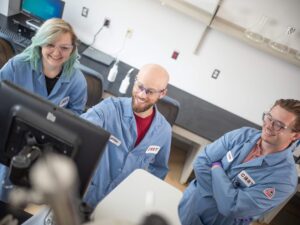
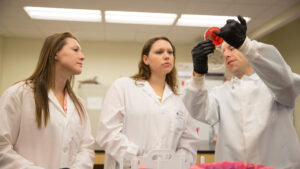
In the BS in Microbiology program at ACPHS, you’ll explore how microscopic organisms impact human health and how we can fight back. From the first day, you’ll be in the lab, working on real-world problems alongside expert faculty in a research-intensive, hands-on environment.
Whether you’re planning to pursue medical school, enroll in graduate school, or launch a career in public health, biotech or the pharmaceutical sciences, this program equips you with the skills and experience to stand out. You’ll have access to state-of-the-art labs, personalized academic and pre-med advising, and rare research opportunities most students don’t see until grad school.
As one of the only colleges in the Northeast offering an undergraduate microbiology degree, ACPHS helps you gain specialized skills that go far beyond a typical biology major. Nearly all of our graduates go on to advanced study or secure positions in health care, pharma or biomedical research.
You’ll also have opportunities to intern or co-op with leading employers in pharmaceutical and health care, like Regeneron, Lilly, Albany Medical Center Hospital and New York State’s Wadsworth Center public-health laboratory, giving you a head start on your career even before graduation.
Microbiology is the study of life at the microscopic level—organisms like bacteria, viruses, algae and fungi that are invisible to the naked eye but have a huge impact on our world. As a microbiologist, you’ll explore how these tiny organisms grow, behave and spread—and most importantly, how to control or harness them to benefit human health and the environment.
From discovering antibiotics to developing vaccines, microbiologists have played key roles in some of the greatest scientific and medical advancements in history. Today, they’re on the front lines of creating life-saving treatments, cleaning up pollution, producing renewable energy and ensuring the safety of our food supply.
Microbiology includes a wide range of specialties. You might study bacteria (bacteriology), viruses (virology) or the immune system (immunology). Medical microbiologists focus on disease-causing microbes and work to stop the spread of illness in humans, animals and plants.
At ACPHS, our BS in Microbiology emphasizes medical, pharmaceutical and public-health microbiology. You’ll gain experience in both basic and translational science, preparing you for high-demand roles in health care, biotech and beyond.

Microbiologists work in research labs, industrial companies, universities, hospitals, government agencies and many other settings.
Graduates of our microbiology program enter the workforce as research scientists, quality-control analysts and research technicians.
Others pursue master’s and PhD programs in a wide range of research areas, including microbiology, immunology, molecular biology and cell biology. Many go on to medical, dental or veterinary school.
According to the U.S. Bureau of Labor Statistics, microbiologists earn an average salary of $84,400 per year, with earning potential varying by industry. Federal government positions are among the highest paying, with an average salary of $112,940. Careers in research and development follow closely at $108,300, while roles in pharmaceutical and medicine manufacturing average $73,830.
Job opportunities are especially strong in metropolitan areas of New York and New Jersey, which have some of the highest employment levels for microbiologists in the country—making ACPHS’ location a strategic advantage for launching your career.
As a microbiology major, you can apply your knowledge and skills to a wide range of fields:
ACPHS faculty bring deep expertise in the molecular mechanisms of infectious disease, with research spanning bacteriology, virology, immunology and cell biology. Many lead externally funded projects, advancing critical discoveries in the field.
Whether you’re launching a new career or want to pursue a graduate program, you’ll receive personalized guidance from faculty mentors and a dedicated advisor.
Starting in your first year, you’ll build skills through hands-on lab work each semester, culminating in a faculty-mentored research project during your senior year.
By graduation, you’ll have a research portfolio on par with what many students gain in graduate school—giving you a competitive edge for careers or advanced study.
Participate in internship and co-op experiences with local pharmaceutical companies like Regeneron and Lilly, which often lead directly to job offers.
Located near Albany Medical Center Hospital, a major teaching hospital, and the Wadsworth Center, New York State’s public-health laboratory, ACPHS gives you unique access to internships, research and volunteer opportunities. Students also benefit from programs like SEA-Phages, NIH-sponsored initiatives and the College’s own Center for Biopharmaceutical Education and Training (CBET).
At ACPHS, you won’t find a one-size-fits-all biology degree. Our microbiology program is designed to give you specialized training tailored to your goals—whether you’re planning for medical school, pharmaceutical research or a career in environmental health.
You’ll work closely with faculty mentors to customize your coursework and research experiences, building a program that aligns with your interests and gives you a clear edge in the job market or grad school.
All microbiology students begin with a strong foundation in how infectious diseases develop and spread. From there, you’ll choose one of three concentrations based on your interests and career goals:
All graduates of the program are expected to fully integrate the theoretical knowledge and laboratory skills of microbiology along with developing scientific reasoning, critical thinking and communication skills. Upon completion of the program, you’ll be able to:
Fast-track your education and launch your research career with our five-year dual-degree program, which combines a BS in Microbiology with an MS in Molecular Biosciences. This accelerated pathway takes a full year off the traditional timeline, giving you a competitive edge, whether you’re heading into the workforce, a PhD program or a professional school.
As a dual-degree student, you’ll build a strong foundation in microbiology while deepening your research expertise through advanced graduate-level coursework and lab experience. You’ll apply to the program in your junior year, and if you maintain a GPA above 3.0, the GRE requirement is waived.
Key Program Highlights:
























Social