

Clinical Laboratory Sciences MS
With an MS in Clinical Laboratory Sciences, you’ll develop the expertise to perform high-level lab procedures, interpret vital patient data and help guide life-saving medical decisions—making a direct impact in hospitals, clinics and research labs.
 Join a clinical laboratory sciences master’s program with a 96% graduation rate, 91% certification exam pass rate and 100% job placement post-graduation.
Overview
If you have a background in biology, chemistry or another life science but aren’t sure where to go next, the MS in Clinical Laboratory Sciences at ACPHS offers a direct path to a rewarding and in-demand health-care career. You’ll gain the skills to become a certified clinical laboratory scientist—someone who plays a crucial role in diagnosing illness and guiding treatment through expert lab analysis.
Clinical lab scientists are the behind-the-scenes heroes of health care. They perform more than 14 billion tests each year across 200,000+ U.S. labs, providing the data that informs 70% of medical decisions. Whether you’re working in a hospital, biotech lab, public health agency or research institute, your work will have a daily impact on human lives.
Why Choose ACPHS?
- Accelerated, NAACLS-accredited program—finish in just two years
- Hands-on training from day one, with cutting-edge lab equipment and real-world clinical rotations
- 91% certification pass rate within a year of graduation. The Board of Certification examination is administered by the American Society of Clinical Pathology (ASCP). See the professional licensure disclosures section for more information.
- Ranked #6 Clinical/Medical Laboratory Science Master’s Program in the U.S.
What You’ll Learn
- Year 1: Focus on clinical disciplines like hematology, clinical chemistry, microbiology and immunohematology.
- Year 2: Gain practical experience through clinical rotations in hospitals and clinics, and complete a capstone project that ties together your learning.
- Bonus certification: A two-course sequence in molecular diagnostics prepares you for additional certification as a Molecular Biologist (MB (ASCP).

Clinical Laboratory Sciences Facts & Stats
Contact the Program Director

Michelle Parent
Phone
“My classmates are just like me in their focus on science and their career goals. And I like the old-school rigorous approach to teaching – they are making us the best in the lab.
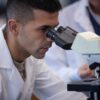 Mustafa
Graduate Student
Mustafa
Graduate Student
Program Details
The Master of Science in Clinical Laboratory Sciences is a 62-credit, two-year program designed to fully prepare you for the ASCP Board of Certification exam and a successful career in clinical diagnostics.
Your coursework combines advanced science with practical application across all major lab disciplines, including:
- Clinical hematology and hemostasis
Explore the physiology and pathology of blood and bone marrow, and master laboratory methods for diagnosing blood disorders. - Immunohematology (blood banking)
Learn the techniques used to identify antibodies critical to safe transfusion practices. - Clinical chemistry and urinalysis
Understand the biochemical principles behind common diagnostic tests for blood, urine and other body fluids. - Clinical microbiology
Study infectious disease diagnostics, including bacteriology, virology and antimicrobial resistance testing.
In addition, you’ll complete a two-course sequence in molecular diagnostics, which prepares you for optional certification as a Molecular Biologist (MB(ASCP))—opening even more doors in molecular testing and genetic analysis.
ASCP Board of Registry Certification Exam:
- Three-year average – 91% Exam Passage Rate
- Class of 2025 – 100% (4 of 4) of exam takers passed within a year of graduation
- Class of 2024 – 83% (10 of 12) of exam takers passed within a year of graduation
- Class of 2023 – 90% (9 of 10) of exam takers passed within a year of graduation
For students entering the professional course portion of the program:
- Three-year average – 91% Graduation Rate
- Class of 2025 had an 83% (5 of 6) Graduation Rate (17% Attrition)
- Class of 2024 had a 100% Graduation Rate
- Class of 2023 had a 90% (9 of 10) Graduation Rate (10% Attrition)
Employment Rate:
- Three-year average – 100% Employment Rate
- Class of 2025 had a 100% Employment Rate
- Class of 2024 had a 100% Employment Rate
- Class of 2023 had a 100% Employment Rate
For more information, please visit accreditation and professional licensure disclosures.
What is Clinical Laboratory Sciences?

Every year, over 14 billion diagnostic tests are ordered—and behind each one is a clinical laboratory scientist helping to uncover what’s happening inside the human body. These highly trained professionals are vital to patient care, using cutting-edge technology and complex lab procedures to detect, diagnose and monitor disease.
As a clinical laboratory scientist (also known as a medical laboratory scientist), you’ll be a critical member of the health-care team. You’ll generate the data that doctors rely on to make informed decisions, playing a hands-on role in the fight against cancer, heart disease, diabetes and countless other conditions.
Up to 70% of all medical decisions are based on lab results—putting you at the center of modern medicine. Whether you’re analyzing blood samples, identifying pathogens or ensuring the accuracy of test results, your work directly impacts patient outcomes and advances scientific discovery.
Experiential Learning in the Clinical Laboratory Sciences MS Program
 Turn your classroom and lab experience into clinical expertise.
As part of the Master of Science in Clinical Laboratory Sciences program at ACPHS, you’ll complete two nine-credit clinical rotations in real-world healthcare environments—working side-by-side with licensed professionals who will mentor you every step of the way.
Guaranteed clinical placements ensure that you’ll gain practical experience in areas like:
- Clinical microbiology
- Clinical chemistry
- Immunohematology (blood banking)
- Hematology and coagulation
- Immunology/serology
- Molecular diagnostics
You’ll rotate through regional hospitals and labs such as:
- Albany Medical Center Hospital
- Albany Stratton VA Medical Center
- Community Care Physicians
- Ellis Hospital
- Glens Falls Hospital
- Nathan Littauer Hospital
- Saratoga Hospital
- St. Mary’s Hospital
- St. Peter’s Health Partners
Your clinical practicum will cover the full diagnostic testing process—from specimen tracking and routine analyses to specialty testing and automated instrumentation—giving you the confidence and skills to step directly into a clinical lab career.
Clinical Laboratory Sciences Degree Careers
 Clinical laboratory science is one of the fastest-growing fields in health care. According to the U.S. Bureau of Labor Statistics, demand for clinical laboratory technologists is projected to grow 11% over the next decade—much faster than the average for all professions.
The field also offers strong earning potential. Salary.com reports that the average salary for clinical laboratory scientists in the U.S. is $75,062, with even higher earnings possible based on experience and location.
ACPHS graduates are in demand and have gone on to work at leading health-care institutions across the region, including:
- Albany Medical Center
- CNY Fertility Center
- Ellis Hospital
- Glens Falls Hospital
- St. Elizabeth Medical Center
- St. Peter’s Health Partners
- Saratoga Hospital






















Social