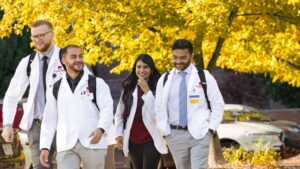
Pre-Health Pathways
Build a strong academic and experiential foundation for medical, dental, pharmacy, veterinary and other health careers through ACPHS’ pre-health pathways and expert advising.
Interested in Pursuing a Career in A Health Profession?
Set your sights on a future in medicine, dentistry, veterinary medicine or other health profession with ACPHS’ pre-health pathways. You’ll build a solid academic foundation, gain hands-on experience and benefit from personalized advising—giving you everything you need to succeed.
ACPHS offers health professions tracks and partnerships with leading institutions to help you pursue a health-care career.
Health Professions Tracks
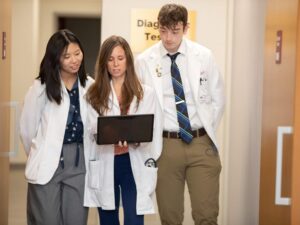
Pre-Med: A Launchpad to Medical School
If you're dreaming of a career in medicine, ACPHS is the perfect place to start. Every academic program here is rooted in science and dedicated to improving human health—giving you a strong foundation for medical school.
Located in Albany’s health-care corridor, our campus puts you steps away from three major hospitals and New York State’s public-health lab. With this kind of access and support, you’ll be well-prepared to turn your passion for medicine into a lifelong career.
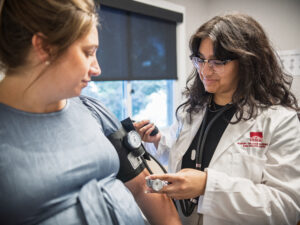
Pre-PA: Lock In Your Seat at Albany Med
Through our unique partnership with Albany Medical College—right across the street—eligible first-year ACPHS students can secure a seat in Albany Med’s Physician Assistant Studies program before classes even begin.
Students interview with both institutions prior to enrollment, and if accepted, their place is guaranteed upon graduation—no GRE required—as long as they maintain a 3.2 GPA each semester and complete the health-care experience requirement.

Accelerate Your Path with A Combined Degree
You can fast-track your future by pairing your pre-med or pre-PA studies with one of our science-focused undergraduate majors.
Explore the Combined Degree Programs page for details on how you can save time and expense while gaining advanced skills that set you apart.
Take Advantage of our Health Professions Agreements
If you want to become a doctor, physician assistant or dentist, ACPHS partners with leading institutions to help you seamlessly continue your education. Check out pathways like:
- Albany Medical College (BS/MD and BS/PA)
- Lake Erie College of Osteopathic Medicine (BS/DO, BS/DMD, BS/DPM)
- New York Institute of Technology (BS/DO)
- SUNY Upstate (BS/DPT)
- Western Atlantic University School of Medicine (BS/MD)
Tips for Getting Accepted to ACPHS: We’re Here to Help You Every Step of the Way
ACPHS has a dedicated team of advisors ready to help you navigate your path to a health-professions career. Here’s how to get started:
- Explore Your Options: Decide which program fits your goals and how to stand out on your application. Attend an Open House and schedule a one-on-one meeting with an admissions counselor, in person or over Zoom.
- Gain Experience: Look for health-care-related opportunities like internships, EMT work, patient-care roles or volunteering with the Red Cross. If your school offers programs like New Visions, Allied Health Clubs or other health-related clubs, get involved.
- Strengthen Your Academics: Plan to take AP, IB or college-level courses such as AP Chemistry, AP Biology, Anatomy and Physiology, Calculus or Psychology. Register for the SAT or ACT.
- Get Organized: Track application deadlines, and note which programs and career paths inspire you for use in your essays.
- Do Your Research: If you’re thinking about becoming a doctor, dentist or physician assistant, learn more about the day-to-day work and the level of education required.
- Prepare Academically: Plan for math and science courses like chemistry and pre-calculus before you graduate. Talk with your high- school counselor about your goals.Review potential exams, such as the SAT, ACT, MCAT for medical school, DAT for dental school or GRE for graduate school.
- Build Connections: Shadow a local doctor or interview a physician assistant to learn more about their roles. Visit an ACPHS Open House to meet people in the field.
- Think Ahead: Consider pairing a strong “base” program, like chemistry or biology, with a professional pathway or combined degree. ACPHS offers flexible undergraduate programs in health sciences to help you get there.
- Challenge yourself academically by taking a rigorous course load, such as advanced, honors or AP classes, including four years of math and science to build a solid foundation.
- Explore careers in health professions.
- Check program requirements and apply early for joint degree/early assurance programs.
- Gain health-care and clinical experience. As you progress, more opportunities for clinical experience arise. In high school, talk to and shadow health-care providers and volunteer in clinical settings like hospitals, physicians’ offices or nursing homes.
- Participate in school or community extracurricular activities. Take on one or two leadership roles. Remember, it’s quality over quantity!
- Request strong recommendation letters from teachers or professionals who know you well.
Stay informed by exploring professional associations and organizations related to your future career. They’re great resources for networking, career advice and staying up to date with the latest in the field.
- Medicine
Choosing a medical career
Considering medical school - Dentistry
American Dental Education Association - Physician Assistant
PA Education Association - Pharmacy
American Association of Colleges of Pharmacy (AACP) Student Center - Podiatric Medicine
Becoming a Doctor of Podiatric Medicine (DPM) - Physical Therapy
Becoming a Physical Therapist - Occupational Therapy
Careers in Occupational Therapy - Optometry
Association of Schools and Colleges of Optometry
Questions about Admissions?

Sarah Ohnsman
Medical Professions Advisory Committee (MPAC): Supporting Your Path to Medical School
The Medical Professions Advisory Committee (MPAC) at ACPHS is here to guide and support you through the medical-school application process, helping you present the strongest possible application.
If you’re interested in the admissions process for medical professions, begin by connecting with an MPAC member as early as possible—ideally at least 1.5 years before graduation. To be considered for MPAC endorsement and support, you’ll need to submit:
- A formal request for a letter of recommendation
- Official transcripts
- Resume
- Personal statement
- A preliminary list of medical schools (including addresses in Excel format)
MPAC will review your GPA, MCAT score, resume, personal statement and the list of medical schools you wish to apply to, ensuring they meet your needs.
If accepted, you’ll be paired with two MPAC members who will help craft a composite letter of recommendation—an all-in-one reference compiled from faculty, supervisors, shadowing physicians and more. They’ll also support your resume, personal statement and application strategy.
If you’re not accepted, MPAC will provide clear, actionable feedback—such as additional coursework, clinical experience or leadership opportunities to improve your application.
MPAC provides a list of recommended courses at ACPHS that meet the typical prerequisites for medical school and prepare you for the MCAT.
You’re encouraged to verify requirements directly with your target schools, as they may vary.
Typical Required Courses for Medical-School Admission
General Chemistry; one year (eight semester hours) with lab
- CHE 101/111 General Chemistry I
- CHE 102/121 General Chemistry II
Organic Chemistry; one year (four-eight semester hours) with lab
- CHE 211 Organic Chemistry I and
- CHE 221 Organic Chemistry II
General Biology; one year (eight semester hours) with lab
- BIO 101/111 General Biology I
- BIO 102/121 General Biology II
Biochemistry; one semester (three credit hours)
- PSC 311 Biochemistry or CHE 311 Biochemistry I
- CHE 312 Biochemistry Lab I
Physics; one year (eight semester hours) with lab
- PHY 212 College Physics I
- PHY 222 College Physics II
Social and Behavioral Sciences; one semester each of psychology and sociology
- PSY 110 Foundations of Psychology (three credit hours)
- SOC 101 Sociology (three credit hours)
Additional Required Courses for Medical-School Admission
Many schools require their students to take at least two writing-intensive courses in the humanities or the social and behavioral sciences. ACPHS courses with the LIT prefix are also cross-listed as ENG. If students want the ENG number to appear on their transcript, they should contact the Registrar’s office.
Math requirements vary among schools, from none to calculus and statistics. Students should check school websites.
Students pursuing Humanities and Social Sciences study literature, history, foreign languages, philosophy, the arts, economics, sociology, communication and other related fields. Requirements and minimum credit hours vary by school, and it is recommended to check the respective school websites. The minimum courses usually include:
- HUM 101/102/201 Pre-Modern, Modern, and Contemporary World (three credit hours)
- COM 115: Principles of Communication (three credit hours)
For additional helpful courses, see MCAT test-prep information below.
Helpful MPAC and Medical School Information
Questions about Pre-Professional Pathways?
Elizabeth Brookins
Questions about the MPAC Committee?
Eric Yager
MCAT Test Preparation for Medical-School Admission
Everything you need to know about the MCAT, test preparation and required coursework for medical-school admission.
This course targets pre-med students preparing for the MCAT and other admissions exams. Offered in person through an arrangement with Kaplan, the one-credit course gives a 40% discount to ACPHS and non-matriculating students.
The course includes core lessons in critical analysis, chemistry, physics, biology, biochemistry, psychology and sociology, featuring live instruction and on-demand videos.
MCAT Test-Prep Facts & Statistics
- 700+ hours of instruction
- 130 interactive science review videos
- 14 full-length MCAT prep tests
Classes are held Tuesdays in October and November from 6-9 pm, are graded pass or fail and serve as a general elective. Students learn about the MCAT sections and scoring system upon completion.
Benefits of MCAT Prep at ACPHS
Kaplan is a leading MCAT preparation service. ACPHS students who register for this course save about $1,000, paying only $1,499. They also gain one-year access to online resources, well beyond the typical six-month period, allowing for additional preparation at no extra cost. Furthermore, current ACPHS students completing this course earn one credit.
To register for the MCAT preparation course, contact Elizabeth Brookins.
Required Courses For MCAT Preparation
If you are interested in preparing for the MCAT, please ensure that you have completed the following courses successfully:
- BIO 101/111 – General Biology I
- BIO 102/121 – General Biology II
- CHE 101/111 – General Chemistry I
- CHE 102/121 – General Chemistry I
- CHE 201/211 – Organic Chemistry I
- CHE 202/221 – Organic Chemistry II
- CHE 311/312 – Biochemistry
- PHY 212 – College Physics I
- PHY 222 – College Physics II
- PSY 101 – General Psychology
- SOC 101 – Sociology (recommended)
Helpful Courses for MCAT Preparation and Medical-School Admission
Below are courses required for some programs and not for others. Please consult with your academic advisor.
- BIO 210 – Microbiology or CLS 327/329 Clinical Microbiology I and II
- BIO 235 – Cell Biology
- PSC 321/322 – Pathophysiology I and II
- PSC 315 – Immunology
- BIO 213/214 – Anatomy and Physiology I and II
- BHS 201 – Medical Terminology
- BIO 225 – Genetics or PSC 312 – Molecular Biology
- MAT 145 – Elementary Statistics
- ETH 310 – Bioethics
- SOC 335 – Global Health
- PSY 321 – Health Psychology
- SOC 325 – Medical Sociology
Additional Resources
Questions about MCAT Test Preparation?
Social