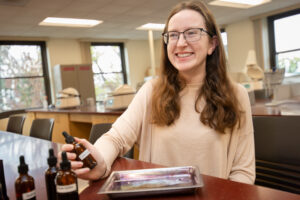
There’s one word Racheal Lavigne would use to describe the four years she has spent so far at ACPHS:
“Fun.”
The Saratoga Springs native is talking about being part of a tight-knit group of friends who study clinical laboratory science (CLS) together and do just everything else together too – shop for groceries, participate in campus events, explore Albany. She’s talking about the support of classmates all over campus who are all heading toward shared goals to make a difference in patients’ lives. She’s talking about being an orientation leader and among the leaders of the Integrative Medicine Club and Pinky Swear Pack, dedicated to raising awareness about childhood cancers.
And like a true CLS devotee, she’s also talking about her time in the laboratory, where they learn to identify cells and the abnormalities that indicate disease within body fluids and tissue samples. The most fun thing she recalled over her last four years was not a social engagement or a club event, but a lab activity called “hematology portfolio.” She described having to “set up camp” in the lab to review stacks of microscopic slides to identify masses of cells within blood samples. She documented cells that were neutrophils, lymphocytes, eosinophils. All manually, without computer assistance. She liked the investigative work and also the little counter next to her that kept pace with her cell identification and pinged when she hit 100.
The real payoff? “It’s seeing the cells that are cool,” Lavigne explained. “It’s fun seeing these different conditions – like a leukemia slide; those are very abnormal cells.”
Lavigne, who received her first professional white coat during a ceremony on April 27, arrived on campus in Fall 2021 to pursue in a 3+2 program combining undergraduate work in biomedical technology with a master’s degree in CLS. She is finishing her academic work now and getting ready to go out on clinical rotations. She’s excited to explore different hospital laboratory environments to learn where she might want to work when she graduates next May. On rotation, she will join other “detectives” on the frontlines of medicine, performing complex procedures and ensuring test accuracy to provide doctors with information needed to save lives.
“I like the bustle and the diversity of hospitals because you never know what you’re going to get,” Lavigne said.
For Lavigne and other CLS graduates will likely have their pick of hospital settings. The Bureau of labor statistics states 12,000 new medical laboratory professionals are needed each year to meet the growing demand for testing, far outpacing the numbers coming out of college classrooms.
Social