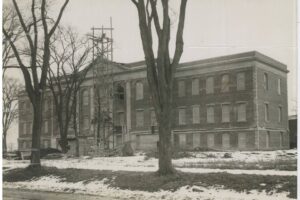
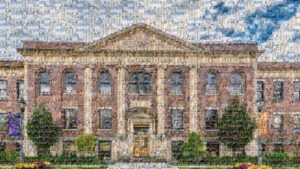
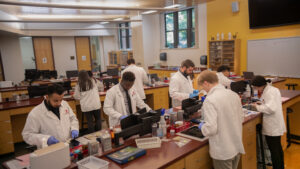
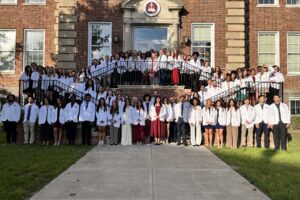
The O’Brien Building at Albany College of Pharmacy and Health Sciences has always served as the anchor of the beloved School. At one time, it held all classrooms, living spaces, the apartment for Dean O’Brien and the cafeteria, among other uses. It remains the main facility for classes, lectures and lab work.
On May 13, 2026, we celebrate a century anniversary of O’Brien’s groundbreaking making it what it is today.
Check out the O’Brien Building Photo Collection from Albany College of Pharmacy and Health Sciences’ Paul Byrnes ’34 Archives.
Excerpt from NY Heritage Archives
In September 1925, ACP once again had to limit its class size due to cramped quarters. According to the 1926 Catalog, the demand for licensed and junior pharmacists far exceeded the supply and larger salaries were being paid.
Though ACP was able to lease space at St. Sophia Hall on Lancaster Street for overflow classes, it was clear that this stopgap measure would not hold for long. Students would “miss the lecture halls, laboratories, corridors and smoking room” on Eagle Street, but they were clearly ready for a change.
By November 1925, at the request of Sen. William T. Byrne and Charles Gibson, President of the College’s Board of Trustees, the Albany County supervisors deeded to ACP a plot of land on New Scotland Avenue for the construction of a new College of Pharmacy. The land, located across from Albany Hospital, originally had been the site of a farm for the Albany Alms House.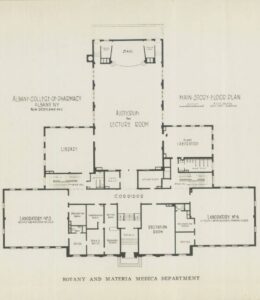
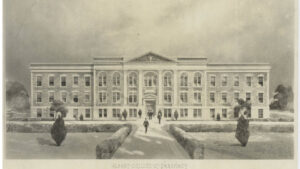
The new building, designed by architect Alex Selkirk, was planned as three stories of tapestry brick and limestone for a cost of $300,000, and would accommodate 500 students. Ground was broken May 13, 1926, with the Honorable John Boyd Thacher, Mayor of Albany, presiding. The cornerstone was set by Dr. Charles H. Johnson, Grand Senior Warden of the State Grand Lodge of Masons.
Members of the Class of 1926 resolved that each graduate would pay the sum of $100 to the Permanent Equipment fund to be used for the facility.
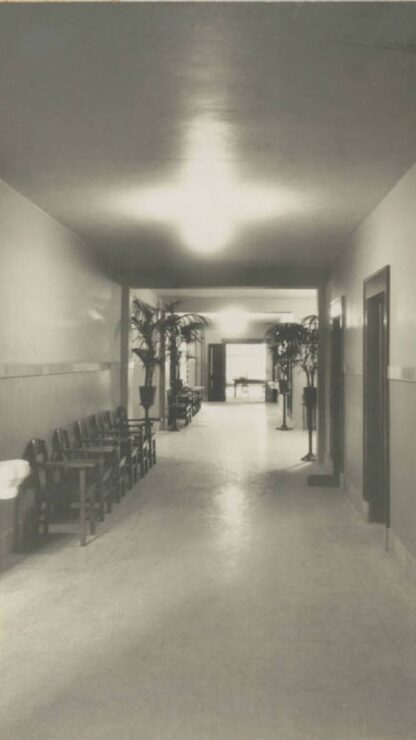
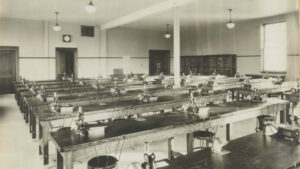
Occupied for the first time in the fall of 1927, the new edifice included labs for Pharmacy, Botany and Materia Medica, Pharmacognosy, Histology and Chemistry; a model pharmacy; an auditorium for 500; a photography room; a library; a gym, complete with showers and locker room; an alumni room and a “co-ed’s” lounge, furnished with stylish wicker furniture.
Then and Now
Social