
5 Questions with Assistant Professor Kevin Miller
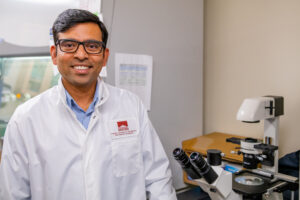
Meet Dr. Kevin Miller, a new professor for the Master’s in Health Data Science program. He brings experience in Data Science, Data Analytics, Machine Learning, AI, Software Engineering, Databases, Distributed Systems, and Health Informatics to his role. He told us this program is essential to the health-care field and we asked him to back it up with data!
You’ve come to ACPHS to support the Master of Science in Heath Data Science program. Tell us why this course is important in today’s world. I am excited to be here and be a part of the new MS in Health Data Science program. This program is timely and essential because health care is becoming increasingly data driven. From electronic health records to genomics and wearable devices, we have more health data than ever before. As a result, we need professionals who can turn that data into meaningful insights. The goal of this program is to prepare students to bridge the gap between data science and real-world health-care challenges. In doing so, they will be empowered to improve patient outcomes, inform evidence-based policies and make a lasting, positive impact on people’s lives.
As you have said, it’s an increasingly data-driven world. What inspired your passion for data science, and how do you keep that enthusiasm alive in the classroom? What inspired my passion for data science is its power to uncover insights that can truly make a difference, especially in health care. I have always been drawn to the idea that behind every data point is a person, a story or a decision waiting to be improved. Seeing how data can drive real-world impact, whether it is improving patient care, streamlining systems or informing public health strategies, is what keeps me motivated.
In the classroom, I keep that enthusiasm alive by connecting concepts to real-world problems. I bring in current case studies, encourage hands-on projects with real data, and create space for students to ask questions and explore their interests. When students see the tangible impact of what they are learning, the energy becomes contagious.
What do students interested in data analytics need to know about how AI will affect the health care industry? Students interested in data analytics should know that AI is already transforming health care and its impact will only grow. From automating administrative tasks to powering diagnostic tools, predicting patient risk, and personalizing treatment plans, AI is reshaping how care is delivered.
But it is not just about technology. Understanding the ethical, regulatory and human aspects of applying AI in health care is just as important. Students will need both strong technical skills and a deep understanding of the health care context to build AI tools that are safe, fair and effective.
Your undergraduate, masters and PhD education is from The University of the West Indies, Mona – Jamaica, West Indies. Tell us about that experience. I am incredibly grateful for my academic journey in the Department of Computing at the University of the West Indies, where I completed my undergraduate, masters, and PhD in Computer Science. The department offered a strong foundation in both theory and application, and it was where I first discovered my passion for using data and technology to solve real-world health challenges.
During my masters, I focused on building a distributed system to monitor patients in a hospital setting. This reinforced my longstanding interest in health-care applications. That interest deepened during my PhD, where I worked on developing a clinical decision support system for personalized drug prescriptions.
Those experiences not only shaped my technical skills but also gave me a strong appreciation for the impact that data-driven solutions can have on patient care. Additionally, with a hospital literally next door, I had the unique opportunity to collaborate closely with health professionals and receive direct, real-world feedback on my work.
If you hadn’t gone into informatics/data/software, what would your alternative career path have been? It’s hard to imagine doing anything else, but if I hadn’t gone into informatics/data/software, I think I would have pursued a career in music or possibly something in the medical field. Both areas have always interested me. Music because it is a form of expression and creativity, and medicine because of its direct impact on people’s lives.

Social