See this article and others in the full issue of 2025 Breakthroughs & Advances
ACPHS leverages strengths and expands beyond boundaries with local partners.
Some things in higher education are better together: research and funding, online technology and human guidance, liberal arts and STEM. The individual items may in some cases hold their own; others require a partner to continue to thrive. Either way, these pairings create depth, well-roundedness and, ideally, improved outcomes.
As a private institution with a longstanding history in Albany, ACPHS has for years benefited from extending its reach through well-chosen partnerships. These collaborations are increasingly important as students’ needs become more diverse, the industries for which they are educated become more complex, and our communities adapt to social change.
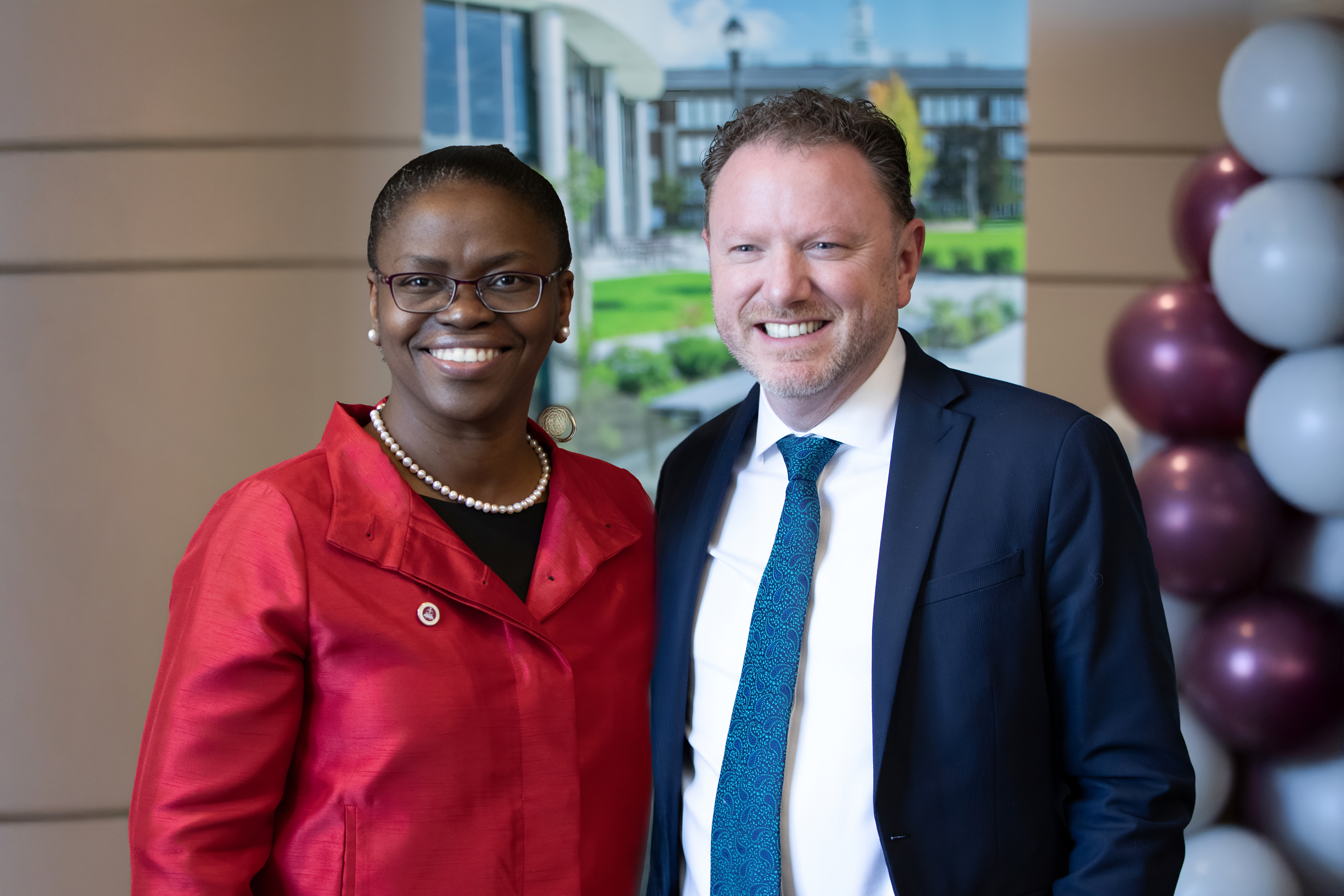
“The right collaborations leverage the strengths of the partners to everyone’s benefit,” said ACPHS President Toyin Tofade. “They empower our students, solidify our institutions and strengthen our communities.”
Herein are a few important ways ACPHS is stretching beyond its boundaries through regional relationships.
Co-Creating a Future
ACPHS’ largest collaborative effort is its intended merger with Russell Sage College, announced in April 2025. Pending regulatory approvals and an expected completion date of Fall 2027, the two nationally recognized colleges will merge to form a new, comprehensive institution— leading in health professions, pharmacy and health sciences, and firmly rooted in interdisciplinary strength.
The combined institution will serve some 4,000 students and have combined assets of $246 million, including $115 million in endowment funds. Within the new institution, Albany College of Pharmacy and Health Sciences at Russell Sage will have two schools: a School of Pharmacy and a School of Biomedical and Health Sciences, which will join four existing schools at Russell Sage: The Esteves School of Education, School of Health Sciences, School of Management, and School of Arts and Sciences.
The merger will create the third largest private institution of higher education in the Capital Region, with the broadest catalogue of programs in the health professions. Added to ACPHS’ storied pharmacy program, new nursing bachelor’s degree and a multitude of health sciences courses that offer paths to medical school, physican assistant programs, dentistry and others, will be Russell Sage’s programs in nursing, occupational therapy, physical therapy, nutrition, mental health counseling, and speech-language pathology, including several at the doctoral level.
While the merged institution will benefit from their shared excellence in health-professions education, benefits for students will also be seen in the ways the schools complement each other. As in the merging of Russell Sage’s exceptional liberal-arts curricula with ACPHS’ dominance in pharmacy and biomedical sciences. Together, these disciplines create well-rounded, innovative thinkers.
“Our merger with ACPHS is a once-in-a-lifetime chance to create a comprehensive university that offers both transformative access and exceptional career outcomes,” said Russell Sage President Matthew Shaftel. “Russell Sage—ranked among the top national universities by U.S. News & World Report for social mobility—brings a century-long legacy in the fields of nursing and education and a 50/50 mix of graduate and undergraduate students. Combined with ACPHS’s top ranking in return on investment, we’re opening the door to bold, interdisciplinary opportunities in the health sciences, arts, business, education, and beyond — preparing graduates to lead and innovate.”
From an academic perspective, Russell Sage students may benefit from the opportunity to engage in research with ACPHS faculty. Likewise, ACPHS students might stretch their talents with classes in graphic design or take on business or education classes to set themselves up as entrepreneurs or academics in their future careers.
Joining will create a stronger whole, leaders from both institutions agree. The increased prominence of being among the area’s largest private institutions will undoubtedly attract more students and talented faculty from a broader area.
That helps both institutions, their students, faculty and neighborhoods. It may also serve as a blueprint for other institutions of higher education looking to thrive in a changing environment.
“We have an opportunity to co-create a future that will be sustainable and a model for others to consider as they see what kinds of things work for us,” said ACPHS President Toyin Tofade.
A Laboratory for Collaboration
The Collaboratory’s name says it all. 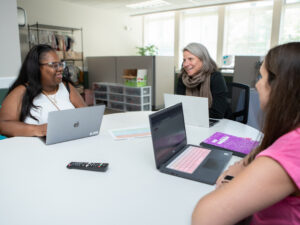
ACPHS’ public-health resource in Albany’s South End was so named as a “laboratory for collaboration,” a place where human-services providers could join forces in social experiments to benefit the health of a medically underserved community just two miles from campus, providing real-world experience to students in the process. Signature services are delivered by ACPHS’ Public Health Pharmacy Team (PHPT) and Trinity Alliance’s Wellness Advocates Linking Communities (WALC) team.
The Collaboratory’s mission is to leverage the talents of ACPHS students, faculty and partner organizations to help narrow health disparities.
Under the direction of Dr. Stacy Pettigrew since early 2024, The Collaboratory’s partnerships and reach have grown. Indeed, Dr. Pettigrew was named ACPHS’ Researcher of the Year in 2024-25 after bringing in nearly $400,000 through five competitive awards for projects tackling urgent public-health priorities like opioid harm reduction, chronic-disease management and food insecurity. Its partners include AVillage, Trinity Alliance of the Capital Region, Home Care Association of New York State, Eddy Visiting Nurse and Rehab Association, Albany Visiting Nurse Association, South End Community Collaborative (SECC) and the Food Pantries of the Capital District.
The community feels the impact of the multiple partnerships, said Eva Bass, who heads two neighborhood nonprofits, AVillage and Bridge Tha Gap. In addition to its service partners, The Collaboratory is a unifier, lending its expertise and administrative support to SECC, Bass said, which brings together multiple non-profits to combine strengths, streamline service provision and hold city leaders accountable to the neighborhood.
Students feel the impact too, Dr. Pettigrew said.
“They get out of the confines of campus and feel like they’re doing something that improves somebody’s life,” she said.
Ayo Momoh and Matthew Shakow were student interns at The Collaboratory in Summer 2025, working with Food Pantries of the Capital Region to provide point-of-care testing for its Food as Medicine program. The pair visited residents to test their A1C and lipid levels before and after they participated in the food program.
Momoh, a student pursuing dual bachelor’s and master’s degrees in microbiology and molecular biosciences, was spending her second summer at The Collaboratory to stretch outside of a controlled lab environment, she said.
“I’m looking for ways I can expand the horizons in which I could apply myself,” Momoh said.
Among other practical ways students participate in The Collaboratory’s programs is by training residents to administer the opioid antidote naloxone, funded by a grant from Albany County. The training includes weekly drop-ins at The Collaboratory’s South Pearl Street office, as well as outreach to libraries, restaurants and other community sites. Between July 2024 and July 2025, Public Health Pharmacist Jacquelyn Dwyer along with pharmacy students on their clinical rotations trained 366 residents and gave away almost 394 free naloxone kits.
“The feedback has been overwhelmingly positive,” Dr. Dwyer said.
In July 2025, Dr. Dwyer and pharmacy student Kathryn Eglinton ‘26 spent an afternoon at Albany’s Honest Weight Food Co-op. Shoppers stopped by their table between picking up bread or nutrition bars. One was a lawyer who represented children; a current client had a parent who’d died from overdose, she said. She was surprised to learn how easy the antidote was to administer.
“This is a need, and it’s real,” she told Dwyer and Eglinton.
Growing an Innovation Ecosystem
In Spring 2023, the Stack Family Center for Biopharmaceutical Education and Training relocated to the Life Sciences Innovation Building at 150 New Scotland Ave. CBET Executive Director Michelle Lewis was charged with helping to reinvigorate the 154,000-square-foot facility that ACPHS had acquired the year before. In just over two years, the LSIB has progressed significantly toward the goal of developing an “innovation ecosystem.” 
Though its halls only recently echoed with the unrealized potential of shiny, empty lab space, the building has filled with visionary thinkers eager to bounce ideas off each other. CBET operates on the fourth floor. Just below, the Neural Stem Cell Institute, with more than 40 researchers and support staff, has settled into its 8,000-square-foot space following its relocation in Fall 2024. Just around the corner is the Accelerator for Medical and Pharmaceutical Sciences (AMPS), a state-funded business incubator that launched in 2024.
Academic relationships are also developing at the LSIB. In Fall 2025, Albany Medical College moved two academic programs onto the second floor. Area students have increased opportunities to learn about biotechnology at CBET through internships and joint biotech educational programs with Hudson Valley Community College, supported by funders like the National Science Foundation. Faculty from Rensselaer Polytechnic Institute in Troy have access to research equipment there through a mutual arrangement that also allows ACPHS researchers to use core facilities at RPI.
“It deepens our institutional relationships and fuels innovation,” said Dr. Michelle Lewis, speaking about the growing number of scientists, researchers and educators at LSIB. “Together, we’re cultivating a vibrant, collaborative community where ideas and discovery thrive.”
The Neural Stem Cell Institute’s founders, Dr. Sally Temple and Dr. Jeffrey Stern, said they are already reaping collaborative benefits from their relocation. For example, CBET has begun making a protein, interleukin 34, used to keep alive microglia, a type of brain cell that NSCI cultures in the lab from stem cells.
“We use a lot, and it’s incredibly expensive,” Dr. Temple said. “If we can have it made in a partnership like this, and it’s high quality and well-QC’d, which is what CBET does, that will be a boon.”
NCSI researchers also enjoy interactions with students who train at CBET, Dr. Temple said. The company has participated in the NIIMBL eXperience, an introduction to biopharma for underrepresented minority students that has been hosted by CBET for several years. HVCC students like Helen Zan also get involved in NCSI’s work; as an intern at CBET working toward an HVCC certificate in biotechnology, Zan helped validate a less expensive method for creating interleukin 34. 
Early in 2025, Skyler Newberry decided the LSIB was the right location for Bella Biologics, a gene-editing company that is pioneering a technology to train the immune system to eliminate toxic proteins; it has the potential ultimately to improve the lives of people with long-term debilitating conditions like Alzheimer’s disease.
The 31-year-old entrepreneur moved to Albany in 2023 when his wife took a job at Regeneron Pharmaceuticals. He’d been looking at New York City and Boston for an incubator to locate his startup when he learned about AMPS from Dr. Lewis – ironically at a conference in Boston – in October 2024.
Access to CBET’s state-of-the-art equipment and expertise has transformed Bella Biologic’s work, providing the resources and guidance needed to thrive.
“It feels like the people who work at CBET are co-workers,” Newberry said.
Albany Med’s Physician Assistant and Certified Registered Nurse Anesthetist programs moved into the building in Fall 2025. The PA and CRNA programs were previously housed over a CVS Pharmacy at 16 New Scotland Ave., less than a mile from the LSIB.
Neurosurgeon and Albany Medical College Dean Alan Boulos believes moving that short distance will make a huge difference for students, who left an urban block of abutting buildings and joined a full-fledged campus, with outdoor gathering spaces, a dining hall, and ACPHS students interested in health care and research.
Even – or perhaps especially – in the 21st century world of digital communications and videoconferencing, in-person interactions matter, Dr. Boulos said.
“What I have learned from my years is the closer the proximity of different disciplines, the greater possibility of unexpected research, of new ways of thinking about old problems,” he said.
Social