How did you spend your summer?
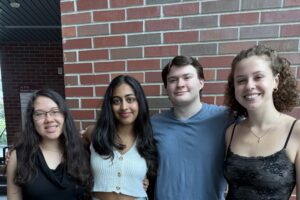
Four ACPHS microbiology students, Emily Louie, Pravalika Gutta, Duncan Schengrund and Izabella Vredenburg, spent their summers interning at the NYS Department of Health’s Wadsworth Center, Regeneron and Rutgers University.
They presented a range of topics in microbiology, infectious disease diagnostics, and molecular biology during a recent seminar hosted by Dr. Vir Singh. The students also shared information about internship opportunities with Eli Lilly and Regeneron, and concluded with a Q&A discussion on funding, application requirements, and highlights from their experience.
Wadsworth Center, NYS Department of Health
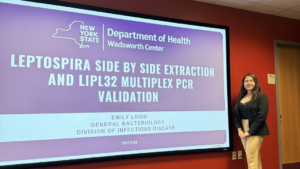
Emily Louie, a 4th year Microbiology BS/Molecular Biosciences MS student, interned at the Wadsworth Center within the Division of Infectious Disease under the General Bacteriology Department. Her project focused on validating a new DNA extraction system and a novel PCR gene marker for diagnosing Leptospira, the bacterium responsible for leptospirosis.
 Leptospira interrogans, the pathogenic strain, is transmitted zoonotically, primarily through rat urine and contaminated soil during rainy seasons, and can cause severe illness including multi-organ failure and Weil’s disease. Humans can become infected when they interact with infected animals.
“Cases have increased in recent years, especially in NYC, so it is important to be able to diagnose it properly,” Emily explained. “My research goal was to move the current assay from one DNA extractor to another as well as add a new gene marker which research has shown to have a higher sensitivity in detecting leptospira to the current assay.”
Emily is continuing this work part-time and her research is going into a validation paper to be implemented on the clinical side.
Regeneron
Nithya Gutta, a 4th year student in the BS Microbiology program on a pre-med track, held her second summer internship at Regeneron, a large biotechnology company that develops new medicines for serious diseases, with a strong emphasis on research and development across multiple therapeutic areas.
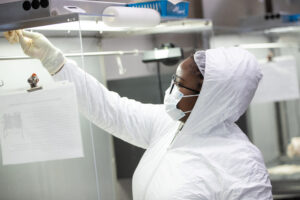
During her internship, Nithya worked often on the TECAN Fluent 1080, and automated liquid handler performing techniques such as PCR and various assays that strengthened her research foundation. She also focused on supporting quality checks on all pharmaceuticals and medicines to ensure no viral contaminants existed.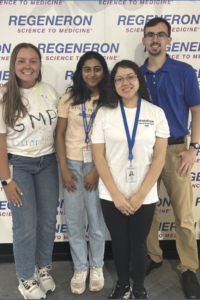
Nithya explained, “Regeneron interns are paid on an hourly basis, with internships typically lasting 8 to 10 weeks at approximately 40 hours per week. Pay varies depending on the department and the intern’s degree level, with graduate students generally earning more than undergraduates.”
Nithya is committed to LECOM to pursue a Doctor of Osteopathic Medicine following graduation.
Rutgers University
Duncan Schengrund, a 3rd year BS Microbiology and Public Health student, presented his summer research internship at Rutgers University studying PE and PPE proteins in Mycobacterium tuberculosis (MTB). MTB is a highly significant global pathogen responsible for approximately 10 million new infections annually and 1.2 to 1.6 million deaths per year, with an estimated 1 billion deaths attributed to it over the course of human history.
His project aimed to clone specific PE and PPE genes, tag them with fluorescent markers (GFP or M. Cardinal), express them in mammalian cells, and use imaging to determine their subcellular localization and potential protein-protein interactions. The project results showed successful protein expression and provided preliminary visual data on protein localization and potential heterodimer formation between PE and PPE partners.
“I generally worked 36 to 40 hours per week and had opportunities to attend weekly seminars with the intern cohort, including journal clubs and guest speaker sessions,” Duncan reported.
Wadsworth Center, NYS Department of Health
Izabella Vredenurg, a 4th year Microbiology BS/Molecular Biosciences MS student, also interned at the Wadsworth Center but within the Diagnostic Immunology Laboratory of the Division of Infectious Disease. She developed MAC-ELISA assays for several rare mosquito-borne and tick-borne viruses: Powassan, Zika, Jamestown Canyon, and Cache Valley Virus. These viruses, classified as flaviviruses and bunyaviruses, can cause symptoms ranging from mild fever and headache to severe encephalitis, meningitis, and birth defects.
 She also screened deer blood samples from the West Coast using a multiplex immunoassay (MIA) and completed CLEP (Clinical Laboratory Evaluation Program) validation packages.
“A notable highlight was that when my supervisor left mid-internship,” Izabella explained, “I became the primary expert on the MAC-ELISA protocol and trained her supervisors—a both challenging and rewarding experience!”
Considering an Internship?
The students encouraged all ACPHS microbiology students to consider applying for internships as you can gain hands-on experience with advanced laboratory equipment and techniques not typically available in undergraduate coursework.
Internships generally prefer students who have completed at least their second year of coursework, with foundational lab skills (e.g., pipetting, PCR, DNA extraction) being important prerequisites.
In addition, most internships are paid, with compensation ranging from approximately $3,000 to $4,000 over the summer depending on the program and student level.
A Canvas module has been created on the micro seminar page to consolidate summer internship opportunities and resources.

Social