This is a student-authored article, by Synthia Ramen’28
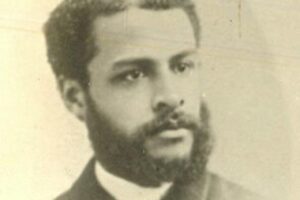
This semester, the Office of Diversity, Equity and Inclusion asked its work study students to research the life of James Gardner, the first Black graduate of Albany College of Pharmacy and Health Sciences.
They were asked to explore who he was, what happened to him, and why so much of his story has been forgotten. Once they started digging, they realized very quickly that this project was about much more than collecting facts.
“This project showed me how easily Black achievements can be forgotten, and how important it is to speak up for the people who came before us,” Public Health student, Synthia Ramen ’28 said. “The more we researched, the more we realized how much of James Gardner’s story was missing simply because no one cared enough to preserve it at the time. That made us feel even more committed to making sure his legacy is finally recognized.”
According to the students’ research, James Gardner was born in Albany in 1864. He graduated from the Albany College of Pharmacy in 1888 and earned the second-place thesis prize that year. He married Caroline Deyo and lived in Albany’s 11th Ward, which is known today as Arbor Hill. Following graduation, he worked as a druggist and was part of the Burdett Coutts Society, a major Black social group in Albany. He was connected to important Black leaders such as Dr. Thomas Elkins, a prominent Black physician who, according to published reports, played a role in Underground Railroad efforts in Albany before the Civil War and Thomas Sands Pennington, a Saratoga Springs Pharmacist.
Gardner died in New York City in 1901, and his body was found near West 40th Street and the Hudson River. He is buried in Albany Rural Cemetery in Lot 97, Section 100.
There is also a lot still unknown about Gardner’s life. For example, it is unknown the exact circumstances of his death, why he was in New York City, why there is no obituary or statements from his wife. Many records from that time are missing or incomplete, which made the research challenging but also showed how much of Black history was never documented with care.
“Working on this project made me realize how little care was given to documenting Black lives in the early 1900s,” said Public Health Student Bella Cowan ’28. “The gaps in James Gardner’s story reflect the way Black people were treated at the time, and that made this work feel even more important. It pushed us to think about how many other stories like his still need to be uncovered.”
To learn as much as they could, the students searched many sources: Family Search, the Library of Congress, the New York Age, Fulton History, the New York State Archives, and the New York City Vital Records site. They contacted the New York City Police Department, the New York State Police, and the New York City Records and Information Services office. Every agency told them that they would need to file formal requests, and that it would take several weeks before they would receive anything. They also reviewed cemetery records, city directories and local history blogs. They also spoke with Julie O’Connor, a local historian who focuses on Black history in Albany.
“It was interesting learning about James Gardner through the time spent researching him,” said Cytotechnology/Molecular Cytology Master’s Student, Audrey DeGraw ’25. “We’re glad that we were able to reach out to a local historian and gain more information about his death and where he is now laid to rest. I hope to visit the gravesite in the spring to pay respects.”
O’Connor shared information about Gardner’s family, his community, and the challenges Black professionals faced during the late 1800s. She helped the team understand why so many details about his life were never recorded and why it is so important to bring attention to stories like his.
The team’s research is still in progress. They are waiting for official records from New York City, to fill in some of the missing pieces.
For now, the team is proud to help bring attention to James Gardner’s life and honor his place in the history of ACPHS. His story reminds all that remembering the past takes intention, patience, and a willingness to look for what others overlooked.
The project had a real impact on all of the students who contributed to the research.
“I really enjoyed the opportunity to research James Gardner’s background and his history. It was a valuable experience that gave me useful insight into his life,” PharmD candidate Oluwanifesimi Kasali ’27.
Social